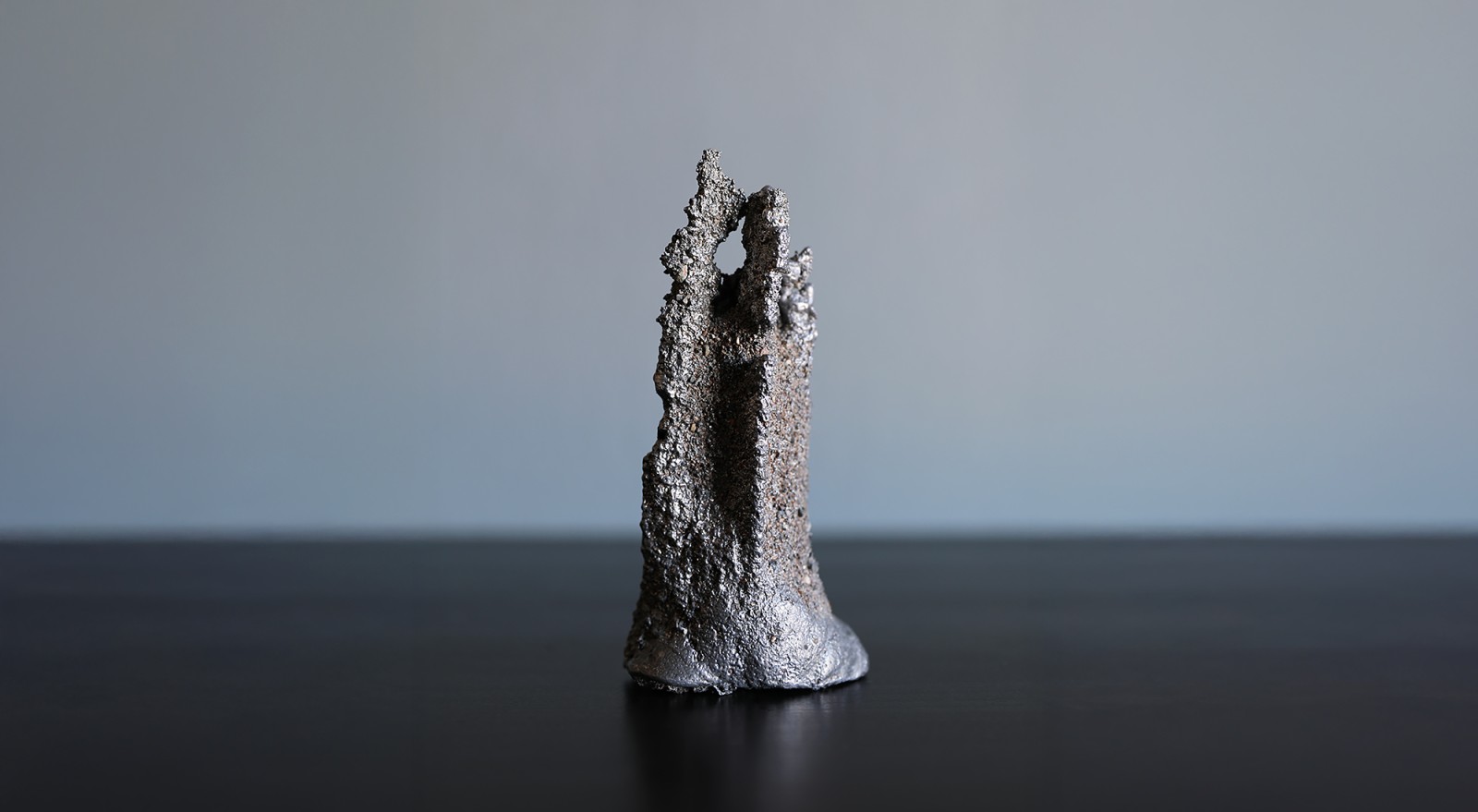
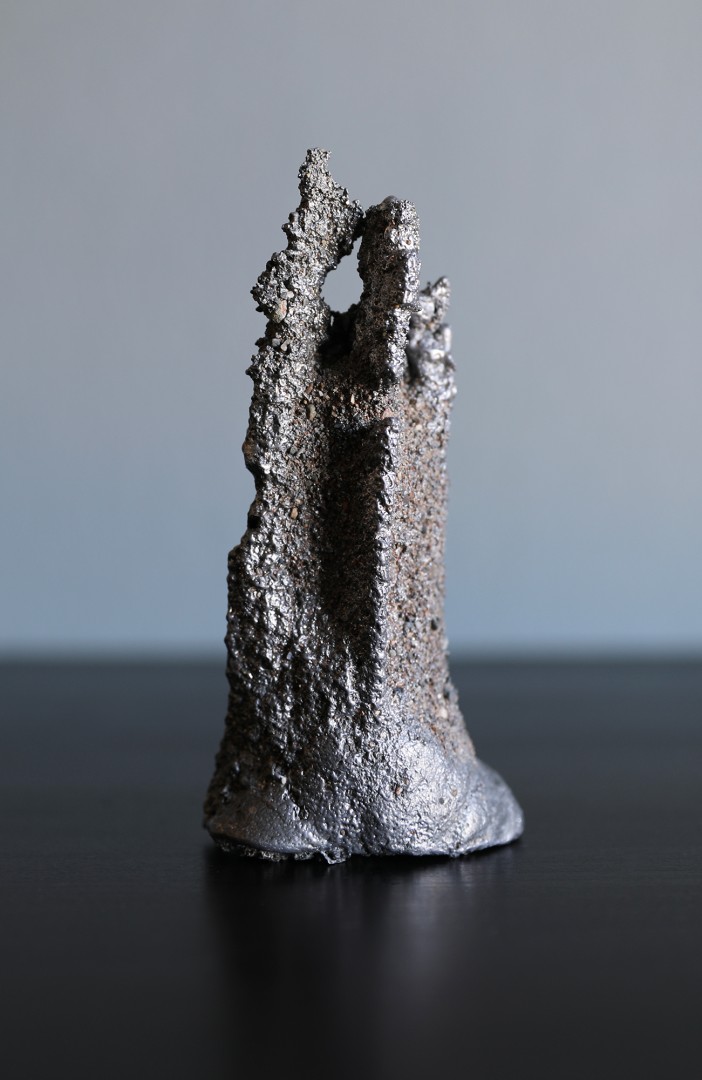
Libyan Sea Figure 3 2019
cast lead, shell fragments, small sea stones, quartz, Saharan dust, sand derived from the erosion of the Asterousia mountains comprising limestone, marl, dolomite, phyllite-quartz, felspar, magnetite, pyroxenes, mica
14.5 x 6.5 x 5.5 cm
ARTIST NOTES
The first casting I ever did took place in the shed of my boyhood home on the coastal fringes of Melbourne, in what was then a small working fishing town. I must have been seven or eight years old.
My father (a post war immigrant from Holland), my two brothers (one younger and one older than me) and I, poured shimmering, liquid lead (melted on a portable camping stove), into shallow elliptical forms that we had created by pressing soup spoons into damp sand that we had gathered from small beach at the end of our street. We were making ‘sinkers’ (fishing weights) for future fishing expeditions.
Recently I have returned to that practice. I have again been pouring lead, again melted on a portable camping stove, again into forms that I have pressed into damp sand - this time the sand was gathered from the beaches that form the northern shores of the Libyan Sea which defines Europe’s southernmost borders. These rugged landscapes are approximately only 350kms from the Libyan coast.
Although modest in scale, these lead figures are physically and conceptually heavy. Each figure is made of the lead of roughly 80 small spherical sinkers, the kind used by the local fishermen in their long hours spent at sea, a sea with which their lives and communities are intertwined. These recast, fishing-weight, shapeshifters are meditations on contemporary systems of migration (official and unofficial), and the journeys made by tens of thousands of people seeking refuge and opportunity in lands safer than those they call home. They are also meditations on the life-changing potentials, and the transformational nature of opportunities that sometimes only come by putting oneself at grave risk, and by staring through fear. Their material weight recalls the law of gravity and the thousands of lives lost each year through unsuccessful attempts to cross the seas to reach European shores. They also suggest another kind of heaviness, the kind that describes the life conditions that drive people, with hope, to risk their lives in the full face of the dangers associated with crossing bodies of water, and of uncertain reception if they make it to the other side.
If I still had those small soup spoon sinkers I would transform them. I would melt them again, sending their materiality on a new trajectory through the lifeworld. I would add them to the locally acquired sinkers and melt them together, mingling pasts and futures. That would help me, and perhaps others, to gain better understanding of the losses associated with migration, of leaving the land one if from in search of safety and opportunity, on the increasing fortification (physical and administrative) of nation-state borders, on the nature of privilege, of humanity, of hope, of risk, and to further question what shapes our individual and collective horizons.
Returning to my childhood casting experience was not a conscious decision, I had forgotten about the experience long ago, but as I started to pour the shimmering lead into the single-pour sand moulds in which these figures were cast those memories came flooding back. It felt timely and good and confirmed, in some way, I am on the right path.
I have never been a very good fisherman, but in my mind, I always made the finest sinkers.
AH ATHENS 2019
Photographs by Andrew Hazewinkel
