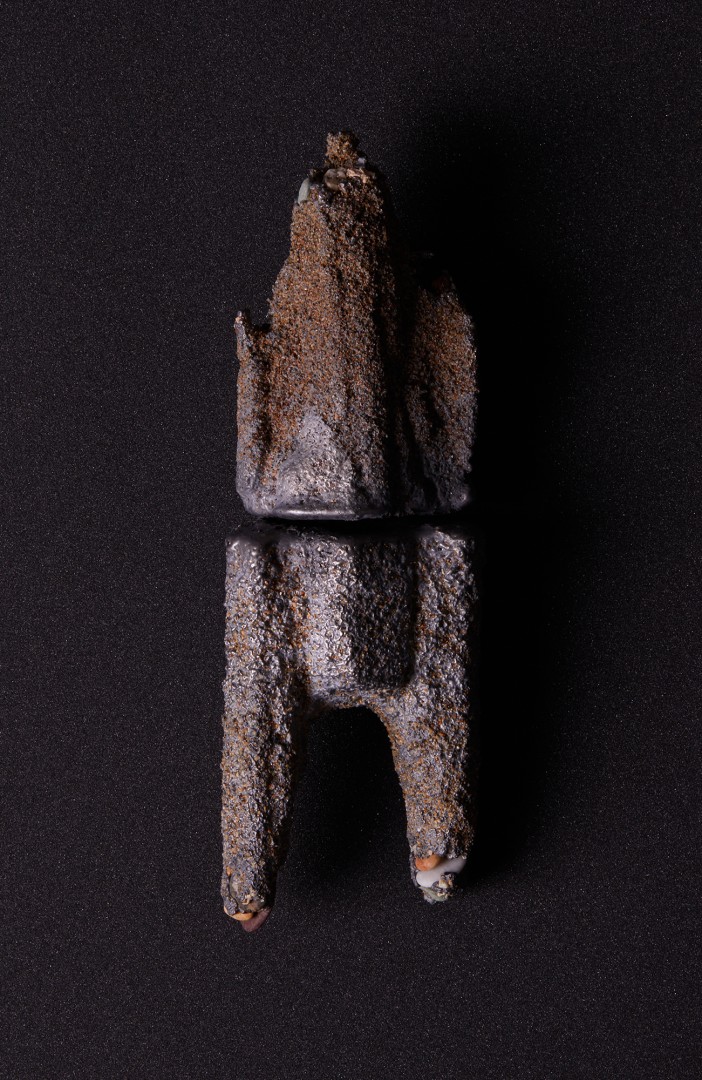
Flamourou 2 2023
lead, shell fragments, granulated coral, small sea stones, intertidal zone beach sand
comprising site-specific geological material including granular quartz, feldspar, biotite
22 x 8 x 5 cm
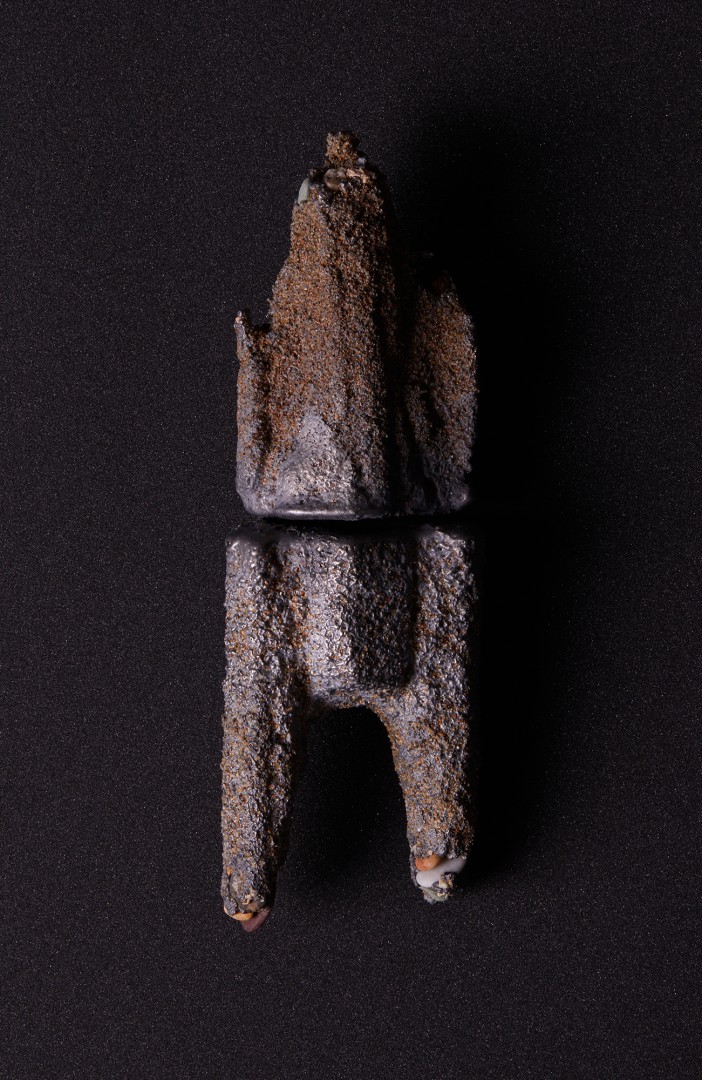
The term autochthonous typically refers to conceptions of indigeneity in relation to people, but it can also be used to describe rocks, fossils, plants, flowers and perhaps artworks. It derives from the ancient Greek word autokhthōn, a compound of autos (meaning self) and khthōn (meaning land, earth, soil). One literal translation of autokhthōn is ‘sprung from the land itself’. In essence, today the term autochthonous signifies something that is inextricably linked to the land of its origin. In geological contexts it refers to rocks, fossils and other deposits formed or found precisely where their constituent elements were originally deposited. Focussing on ‘formed’ rather than ‘found’ it is appropriate to consider Hazewinkel’s cast in-the-earth figural entities as autochthonic to their place of creation (after which each is named).
Hazewinkel’s distinctive, in-the-earth, landscape casting practice approaches the landscape as an active co-contributor participating in processes that generate unique-state, location-specific, figural entities, shaped as much by the material qualities and stratigraphies of their place of origin as by his understanding of culturally diverse histories of human figuration. The figures he creates blend and embody the geological, marine, and anthropic temporal registers of their place of origin. This commingling of temporalities occurs through the presence and agency of the location-specific materialities ( autochthonic and foreign, ancient and contemporary) captured in each figure's surfaces and volumes. Cast at a scale reflective of ancient votive and devotional objects, these figures evoke ideas and experieces that can be associated with the movement and displacement of people, their cultures, and objects as they mingle bodies, histories, materials and remembering.
Photographed by Giorgos Vitsaropoulos
