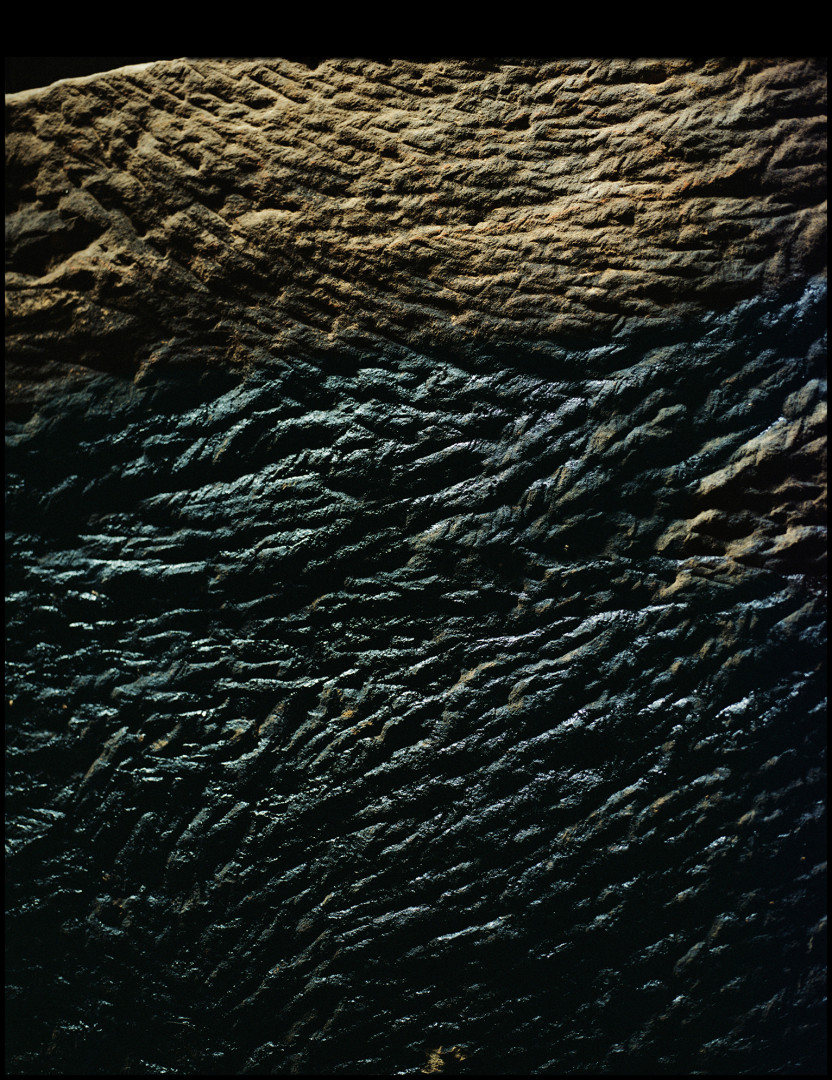
Historyskin 2016
silver halide chromogenic darkroom print
100 x 76 cm
Ed 3 + 1AP
50 x 38 cm
Ed 3 + 1AP
Hazewinkel is interested in sites and objects wherein the human made and the naturally occurring overlap. Skyscape Archaeology (also known as Archaeoastronomy), is a discipline that studies the orientation of ancient monuments - temples, pyramids, tombs etc. in relation to celestial phenomena - solstices, equinoxes, eclipses, and transits of comets. It helps us to better understand the relationships between people of proto-historic cultures and the heavens, and their belief systems related to the extra-terrestrial and the afterlife.
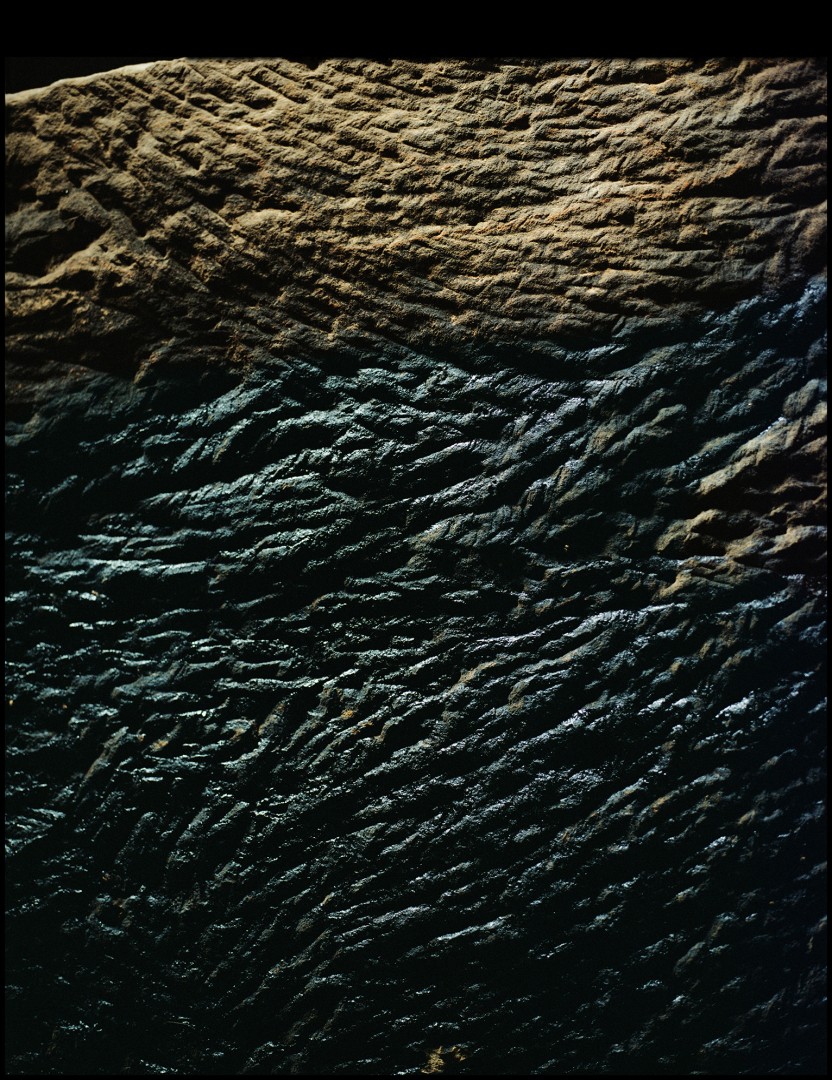
This image represents a detail of a wall in a small underground room that is cut directly into the sandstone bedrock that forms part of the landscape of western Sicily. The small room is part of a late Neolithic six-room complex that extends across two levels. The entire complex is cut directly into the bedrock. The main room of the complex is a bell-shaped chamber (a tholos), with an oval plan measuring 13 x 13.5m. It rises to a height of almost 16m. This roughly four-story underground chamber is open to the sky, being perforated at the top by an oculus 80 cm in diameter.
Created around 2500 BCE, this remarkable complex retains many of it’s secrets. Recent archaeoastrological findings reveal that a light ray filtering through the oculus acts as a sundial, and that a hole on the southern side of the main chamber allows a light ray to penetrate the space illuminating the centre point of the main chamber’s oval floor on the equinox. These light transition phenomena have relationships with the light rays that travel through the oculus of the Pantheon at Rome (orginally a polythestic temple), and more contemporary light activating environments such as those by the American artist James Turrell, notably Roden Crater (1977 - ongoing), and Nancy Holt’s artwork Sun Tunnels (1973 - 1976). Hazewinkel worked with the natural light penetrating the chamber complex to capture this image which represents the residual, rhythmic marks of a repetitive movement, inscribed into the bedrock through a gesture, that is for the artist, simultaneously excavation and sculpture.
These walls, and the spaces they define, were created by a proto-historic culture, by a people in that artistic and imaginatively fertile moment that immediately precedes the development of a writing system. Hazewinkel describes the sensation of being in their underground space like being surrounded by a body of water, perhaps an ocean.
