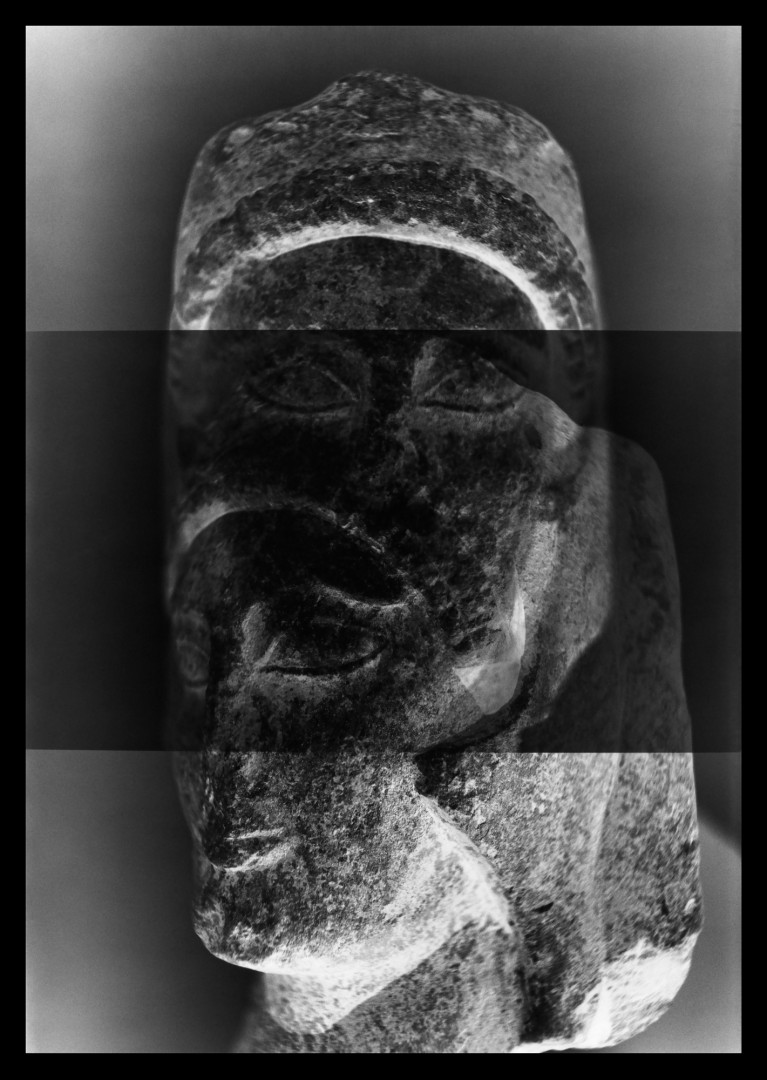
Disputed Becoming (Omphale - Herakles - Omphale) 2019
gelatin silver print on fibre-based paper.
56 X 39 CM
Ed 3 + 1 AP
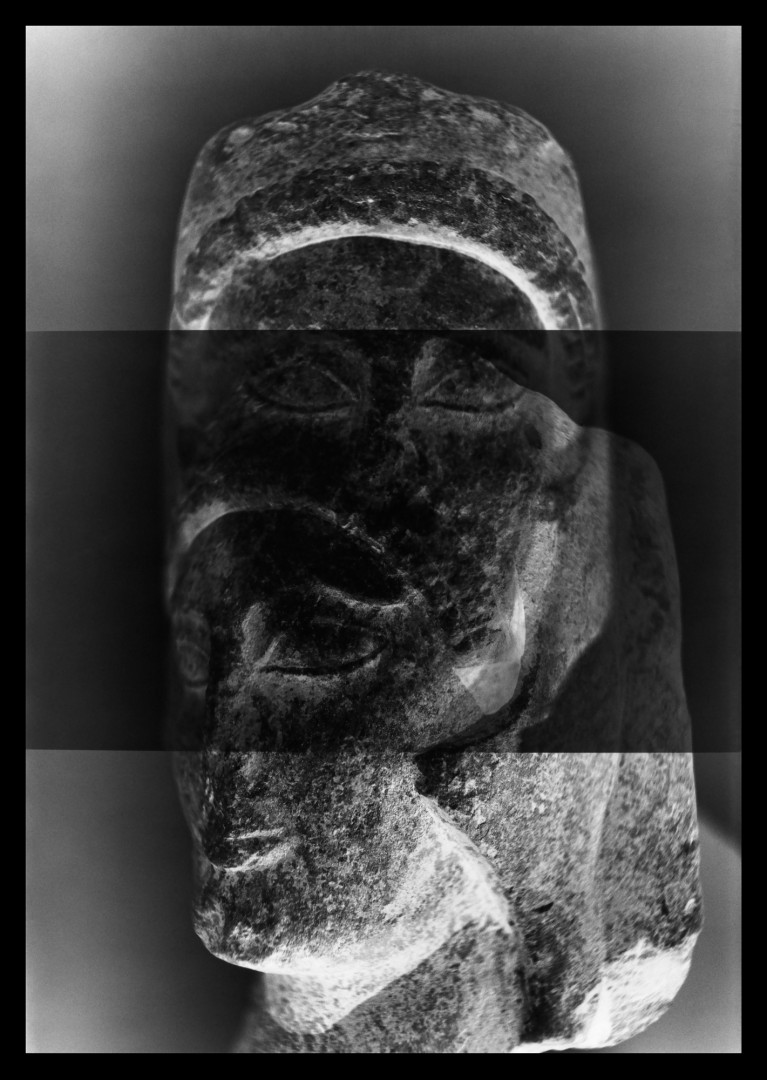
Here two views of the same object overlap on a strip of medium format film. The two exposures merge in the middle creating a commingled figure. Hazewinkel explains that the overlap, an unitentional outcome of an otherwise straightforward documentation project, was caused by a mechanical problem with the film progressing mechanism of Hassleblad C/M 500 that he uses for his analogue medium format work. The resulting doubled image has become an important part of Hazewinkel's ongoing creative research project that investigates the entanglements between two figures that reside in the overlaps between Western (Graeco-Roman) and Eastern (Lydian) myth.
The archaeological subject matter of this photograph is a slightly smaller than life-size limestone head of a statue (c.500 BCE) that represents either Omphale or Herakles. For the artist, its contemporary conceptual considerations concern gender fluidity, hybridity and plurality. What, and how much we know of each of the two identities presents an imbalance. Very little is known of Omphale, and the hyper-masculine Greek hero is ubiquitous.
We know that Omphale was a powerful Eastern woman, a Lydian queen who ruled independently. Within European contexts, the narrative most associated with her centres on Herkales' enslavemnet to her, during which (according to European records), she insisted on an exchange of garments and gendered roles. The unmistakeable iconography of the Greek hero wearing Eastern womens clothing and jewelery while performing womens work exists only in European contexts, while Eastern iconography of Omphale wearing the classical attributes of Herakles (the lion skin and club) is much older.
In 1899 when this stone head was acquired by the National Archaeological Museum of Greece it was one of the earliest objects to enter the collection. Archival records show that at the time of its accession it was catalogued as a head of Omphale, soon afterward the catalogue entry was changed to describe it as a head of Herakles. Since then scholarly attributions have continued to vary, sometimes this Omphale becomes a Herkales, and sometimes this Herakles becomes an Omphale.
Photographic permission courtesy of the National Archaeological Museum Athens
